Whether you love Crepe Myrtles, hate Crepe Myrtles, planted your own Crepe Myrtles, or moved into a new home with Crepe Myrtles already there. Everyone seems to have a passionate opinion on this subject. Do not get upset everybody. I am referring to the practice of cutting mature Crepe Myrtles back by usually 50% or more. The name Crepe Murder was applied to this practice by an article in Southern Living that came out in 1997 and it stuck! The term Crepe Murder will get some people extremely fired up. Before this happens, let's take a moment and look at a few things from different perspectives.
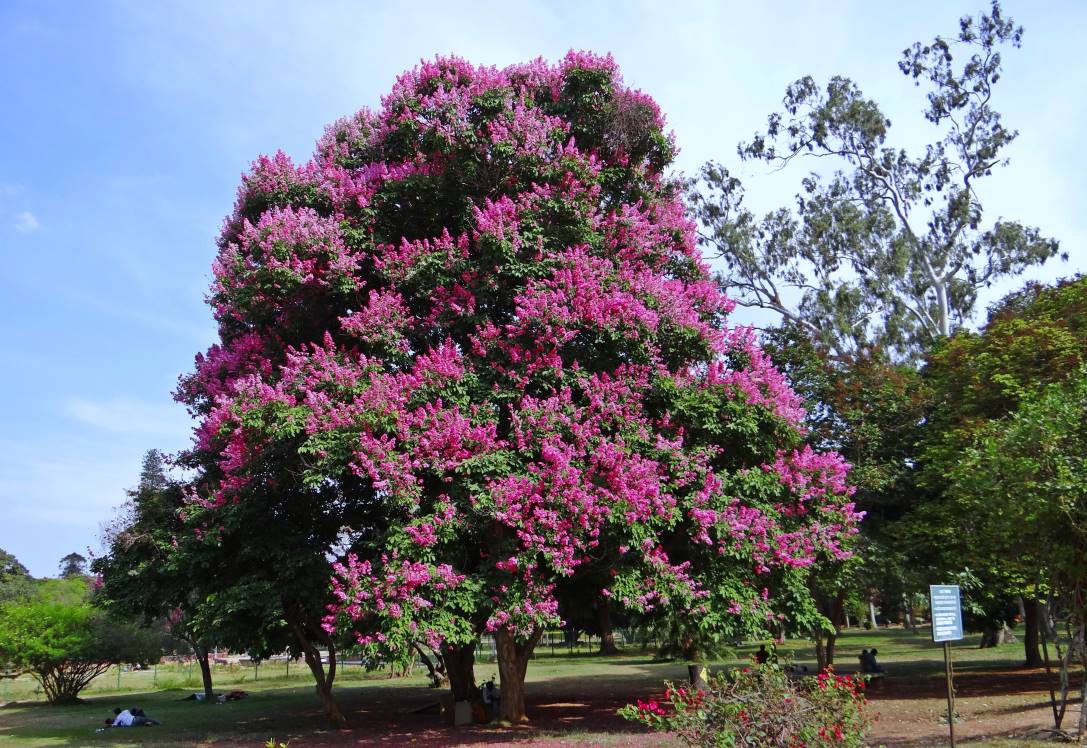
While we know that opinions on this subject vary widely and some of us can get very passionate about his or her stance, I think we can all agree that the majority of us care about our homes and try to make decisions that are in the best interest of our homes and maintaining them safely. Now that we have all taken a breath let's look at a few facts. Crepe Myrtles are beautiful in the Spring and the Summer when they bloom, and their exfoliating bark stands out as a unique characteristic year-round. Crepe Myrtles will only bloom on new wood also known as this year's growth. This means that as Crepe Myrtles get older and larger, the pretty blooms keep getting higher and higher each year. Depending on the type of Crepe Myrtle you have, it could grow anywhere from 3' tall for dwarf cultivars or up to 30' for larger cultivars. Depending on where this Crepe Myrtle is located this could be good or bad.
If it grows to 30' and it is located too close to your home (where a lot of them seem to end up) it could block windows, beat or rub on gutters, or hang over your roof and act as a ladder for critters looking to get on your roof or in your attic. This can create a situation that must be addressed immediately. Usually, the homeowner has two options in this situation. You either remove the Crepe Myrtle entirely or you cut it back to a height that prevents this from happening again and it must be maintained at this height. If cutting it back is the route taken, when determining the height to make the heading cuts at you must keep in mind that the new shoots will add several feet to this height in between annual pruning. It also needs to be an easy height to work at because this is the height they will need to be pruned at annually for the life of the tree.
Topping trees is one of the worst things to do to a tree and should be avoided at all costs. That being said, sometimes you must choose the lesser of two evils. Do I lose my entire tree? Or do I take a chance and try something that may save it? There is a pruning practice known as Pollarding that can be done on certain types of trees when they are young and yield awesome results. Crepe Myrtles are one of the trees this pruning practice works very well on, IF it is done properly. When done properly it starts at a young age. The juvenile tree is topped at the desired height and then the new growth is pruned back to just above the original cuts every year or every couple of years. The original cuts that have sealed and grown new shoots from are now known as the knuckles. As the tree ages and is cut back like this to the knuckles every year or every couple of years you will get more shoots and more blooms each time this is done. This is the pruning practice that Crepe Murder is trying to replicate. There are a couple problems that may occur when doing this to a mature tree though.
Trees make their own food in their foliage by a process called photosynthesis. By topping mature Crepe Myrtles, you are removing their foliage and their energy source. If they do not have enough stored energy in reserve, you could put them into decline or kill them before they have a chance to recover. Another problem is the size and type of cut required to reduce the height to the desired height. A heading cut is required and it will leave an open wound that could allow pathogens into the tree. Trees wounds don't heal, they seal b
One last thing. Crepe Myrtles will tolerate light pruning year-round if need be but for major pruning or annual pruning, it should be done in February when they are dormant. These are things that should be considered before making your decision. These are also things that should be considered before accusing a neighbor of murder.