


Deep Root Fertilization For Your Trees and or Shrubs
We here at Good Guys Tree Service thrive on honesty and quality customer service. The health of your trees and shrubs are a highly valuable element to your home landscape. Proper trimming and pruning boosts new bud formation and promotes durable upward growth patterns.
What many homeowners don’t realize is how beneficial fertilizing is to add vibrancy and curb appeal. By setting an appointment with our certified Arborist, we can help with assessing the specific needs of your plant life.
Certified & Licensed
Oak Wilt certified and licensed by the Texas Department of Agriculture, our certified Arborist will ensure we safely maximize your property’s potential, without overselling you anything it doesn’t need.
Fertilizing before or during summer months can prepare your trees and shrubs to overcome the trauma that the Texas heat brings.
Please call today and set an appointment with our certified arborist for your tree and shrub health evaluation. Ask about our current promotions to get the best value for your tree care needs!
Why Fertilize Your Trees & Shrubs?
Natural debris like leaf litter, grass clippings, and branches would normally create organic matter that Mother Nature uses to give nutrients to the soil. Since it is common practice to remove the debris from our yards, the need for fertilizer grows.
Some other factors that call for use include: Pre and Post construction or new pool construction which can take away or alter the root system of established trees. Soil compaction, like continually driving over an area, denies the ability for much needed gas exchange. Intense summer heat and drought can further stress your trees over the years. With multiple stressors compounding on your trees and shrubs, they can become vulnerable to other diseases.
Using a slow-release fertilizer high in nitrogen, phosphate, and potassium is the proper deep root fertilization treatment that will feed your trees for a complete year. It also can help Mycorrhizae flourish underground. Mycorrhizae is a good fungus that has a symbiotic relationship with plant roots (like how probiotics improve our gut health). Multiple benefits of mycorrhiza health can include:
- Overall plant health & vigor
- Increased resistance of pathogens
- Strength after transplantation
- Efficiency in absorbing water and nutrients from the soil, especially in smaller root vessels
- Improving tolerance to drought conditions
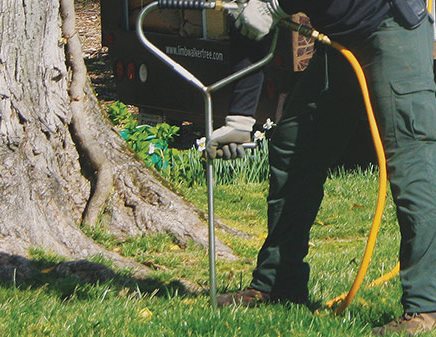
Application will be by our technician, directly injecting into the soil under your tree’s canopy with a grid pattern every 2-3 feet. Depending on your soil composition, it will be administered at a depth of 4-6 inches below ground level.

Deep Root Fertilization FAQs
Everything you need to know about deep root fertilization for your trees and shrubs
Deep root fertilization is a tree and shrub care technique where a slow-release fertilizer rich in nitrogen, phosphate, and potassium is injected directly into the soil beneath a tree's canopy rather than applied on the surface. Our tree care professionals use a specialized tool to administer the fertilizer at 4 to 6 inches below ground level, following a grid pattern spaced every 2 to 3 feet across the root zone.
This method bypasses the compacted top layer of soil and delivers nutrients exactly where the roots can use them. It also supports the development of Mycorrhizae, a beneficial fungus that lives in the soil and helps roots absorb water and nutrients more efficiently. The result is a treatment that feeds your trees and shrubs for a full year from a single application.
In a natural forest environment, trees get nutrients from decomposing leaf litter and organic debris on the forest floor. In Austin yards, that debris is routinely cleared away — leaving trees without their primary natural nutrient source. Deep root fertilization replaces what the landscape maintenance cycle takes away.
Central Texas soil also presents additional challenges: clay-heavy soils compact easily, reducing oxygen and water flow to roots. Austin's intense summer heat and periodic droughts compound the stress. Deep root fertilization is specifically designed to address these conditions by pushing nutrients and moisture-retention support past the compacted zone and directly into the active root area where it counts.
Several conditions signal that your trees or shrubs could benefit from deep root fertilization in Austin. Look for yellowing or pale leaves (chlorosis), sparse or undersized foliage, slow growth compared to prior years, or a general lack of vigor and color. Trees recovering from construction activity, new pool installation, or soil compaction are especially good candidates.
The Central Texas climate itself is a contributing factor — intense summer heat, extended drought periods, and compacted urban soils all deplete the nutrients trees need to stay healthy and resist disease. If your trees took a beating last summer or look stressed heading into the season, a deep root fertilization treatment is one of the most effective ways to rebuild their strength from the ground up.
Surface fertilizer application has a significant limitation: it sits on top of the soil and has to work its way down through whatever compaction, clay, or thatch exists between the surface and the root zone. In many Austin landscapes, a meaningful portion of that fertilizer never reaches the roots at all — it's absorbed by turf, washed away by rain, or blocked by compacted soil.
Deep root fertilization skips that entirely. By injecting the slow-release formula directly into the soil at 4 to 6 inches depth in a grid pattern beneath the canopy, nutrients are placed at the precise depth where feeder roots are active. This makes the treatment significantly more efficient and more effective than broadcast surface application, particularly for established trees and large shrubs dealing with Austin's clay-heavy soils.
In Central Texas, deep root fertilization is most effective when it aligns with the tree's growth cycle. Late winter through early spring — as trees are coming out of dormancy — is an ideal window, as it gives them a nutrient boost right when they're ready to push new growth. Fall is also a strong time, helping trees store energy reserves before the stress of summer.
That said, deep root fertilization can benefit stressed or depleted trees at virtually any time of year. If your trees were hammered by last summer's heat or are recovering from construction or drought damage, waiting for a perfect window isn't always necessary. Our team will assess your specific trees and recommend timing that makes the most sense for their current condition.
A single deep root fertilization treatment from Good Guys Tree Service feeds your trees and shrubs for approximately one full year. The slow-release formula is designed to break down gradually in the soil, providing a sustained supply of nitrogen, phosphate, and potassium over that period rather than a single short-lived spike.
Most trees and shrubs in Austin benefit from annual treatments to consistently replace the nutrients that the local soil and climate deplete over time. Trees under elevated stress — those near construction zones, dealing with soil compaction, or recovering from drought — may benefit from more tailored scheduling, which our team can assess during a visit.
For most healthy trees and shrubs in the Austin area, once per year is the standard recommendation. The slow-release formula used in deep root fertilization is calibrated to sustain nutrient delivery for a full 12-month cycle, so annual treatments keep your trees consistently supported without over-applying.
Trees in high-stress situations — recovering from transplantation, dealing with compacted soils from nearby construction, or showing signs of disease susceptibility — may need more frequent attention or a customized plant health care plan. Our team evaluates the specific needs of your trees rather than applying a one-size-fits-all schedule, because the right amount of fertilization depends on the tree, the soil, and the season — not a generic calendar.
Yes — this is one of the primary reasons Austin homeowners invest in deep root fertilization. The treatment directly addresses two of the biggest threats that Texas heat and drought pose to tree health: nutrient depletion and reduced water absorption efficiency.
By feeding the root system with a sustained-release formula and supporting the growth of Mycorrhizae fungi in the soil, deep root fertilization improves the root system's ability to absorb both water and nutrients — even during dry conditions. Trees that receive regular fertilization treatments are measurably better equipped to tolerate drought stress, resist pathogens, and bounce back from the physical trauma that extreme Texas summers can cause. It's one of the most proactive steps Austin homeowners can take to protect their landscape investment.
DIY fertilization products are widely available, but they are not the same as professional deep root fertilization. Consumer-grade fertilizers are almost exclusively surface-application products — meaning they face the same compaction and absorption limitations that make surface fertilization less effective. Professional deep root fertilization requires specialized pressurized injection equipment that physically delivers nutrients below the compacted soil layer.
Beyond the equipment, a professional assessment matters. Good Guys Tree Service evaluates each tree's specific condition before recommending treatment — including whether fertilization is appropriate, what formula is right, and how the application should be spaced. For Austin homeowners with established trees, the investment in professional treatment typically delivers far better results than any off-the-shelf alternative. It's also worth noting that over-fertilization can damage or kill a tree — proper dosing is as important as the treatment itself.


